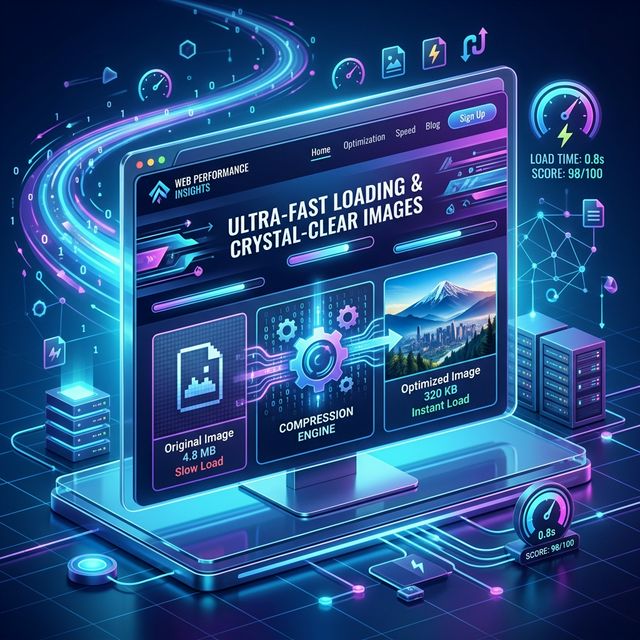
الدليل الشامل لتحسين الصور لأداء الويب
In the modern digital landscape, speed is not just a luxury—it is a critical factor for user retention, search engine rankings, and overall conversion rates. As web pages grow increasingly complex, the weight of visual assets has become the primary bottleneck for mobile and desktop performance alike.
The Weight of Visual Assets in 2024
According to recent industry audits, images often account for more than 60% of the total bytes downloaded for a typical web page. If these assets are not properly optimized, you risk high bounce rates and poor mobile performance. The "First Contentful Paint" (FCP) and "Largest Contentful Paint" (LCP) are two Core Web Vitals that are heavily influenced by image loading speeds. Our Image Converter tool is designed to address this by providing a high-fidelity bridge between legacy formats (JPEG, PNG) and modern, efficient standards.
Why WebP is the Gold Standard for Modern Browsers
Developed by Google, WebP provides superior lossless and lossy compression for images on the web. WebP lossless images are 26% smaller in size compared to PNGs, while lossy images are 25-34% smaller than comparable JPEG images. By using our tool to convert your library to WebP, you are directly investing in a faster user experience.
The technical magic behind WebP lies in its use of predictive coding to encode an image. This method uses the values in neighboring blocks of pixels to predict the values in a block, and then only encodes the difference. This resulting efficiency allows for transparency (alpha channel) and animation, making it a versatile replacement for both PNG and GIF.
Lossy vs. Lossless: Making the Right Scientific Choice
Understanding the mathematical trade-offs between lossy and lossless compression is essential for professional web design. Lossy compression (common in JPEG and WebP) discards data that the human eye is unlikely to notice, resulting in drastic file size reductions. Lossless compression (PNG, lossless WebP) maintains every single bit of original data but results in larger files. For hero images and photography, lossy is almost always the correct path. For logos and screenshots with sharp lines, lossless maintains the necessary clarity.
Batch Conversion Intelligence and Workflow Optimization
Manually optimizing every icon or hero image is an inefficient use of professional time. Oyaam leverages browser-based batch processing to handle hundreds of images simultaneously. This ensures that your entire asset pipeline remains performant with minimal overhead. By processing images locally in the user browser, we eliminate the need for expensive server-side processing and ensure that your data is never uploaded to a third party.
"Performance is a feature, and image optimization is the lowest-hanging fruit for any developer looking to improve their Core Web Vitals and search engine visibility."
Global Best Practices for 2024
- Always use Next-Gen Formats: Priority should be given to WebP and AVIF. These formats offer better compression than JPEG/PNG.
- Responsive Delivery: Use the
<picture>element to serve different sizes based on the user device viewport. Avoid serving a 4K image to a mobile phone. - Privacy First: Use local tools like Oyaam to ensure your proprietary assets are never uploaded to unknown servers.
- Lazy Loading: Always implement the
loading="lazy"attribute for below-the-fold images to prioritize initial page load speed.
The Technical Architecture of Browser-Based Conversion
Oyaam utilizes the modern Canvas API and File System Access API to perform these transformations. When you upload a file, the browser reads the binary data into a canvas element, where we can manipulate dimensions and quality settings before exporting it back as an optimized blob. This architecture is not only faster than traditional server-based uploading but significantly more secure.
In conclusion, image optimization is a continuous process that requires a combination of the right tools and a disciplined workflow. By integrating Oyaam into your asset management pipeline, you can ensure that your website remains fast, accessible, and competitive in an increasingly speed-sensitive market.